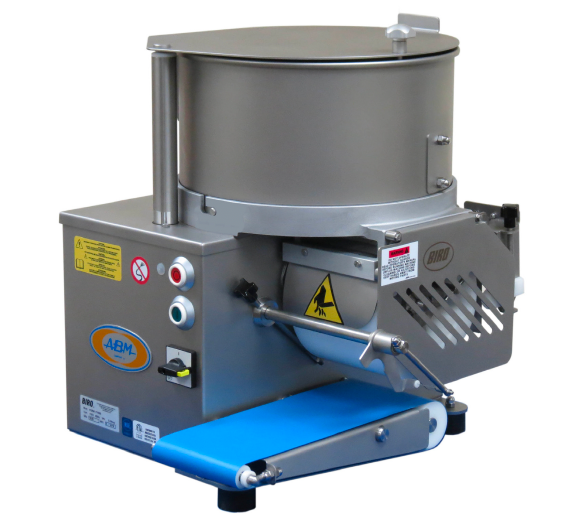
Model F1000N Patty/Food Former
Model F1000N Patty/Food Former
The BIRO F1000N, & F2000PLUSB Patty/Food Forming Machines are designed for production of a wide variety of meat and food products, with maximum production output capability from approximately 1000 to 3500 cycles per hour. A large number of drum mold die shapes are available. They vary from the standard round shapes of different diameters, to special shapes such as square, oval, rectangle, chicken nuggets, pork chop, etc. Call your representative for more information. The key feature of this machine is the design of the Mold (die) in the drum. The operator can select product
weights by changing the drum die depth (thickness) up to 1¼” (32mm). You do not need different die cups and plates each time you want to change weights. The Food Former Models are compact, have a small foot print, and are easy to clean-up. They are reliable, versatile and are a true Value-Added Profit Center all their own.
- The Formers Models F1000N, F2000PLUSB approximate per-hour output is achieved under absolute best conditions, i.e., quality of product, cold product, low environment temperature and a cold machine. This output capacity does not take into account stop-ping and filling the hopper with product or stopping the machine to collect patties from the conveyor, etc.
- This BIRO Food Former literature illustrates various mold shapes and will help you decide what is available. One Poly Drum
Single-Hole Mold is supplied as standard equipment (no charge) with each former. See Poly Drum Single Hole (Round, Oval,
Rectangle or Square Shape) Molds selection chart and other optional extra cost Drum Molds.
- A two-hole mold drum is available in small round shapes, but the product will be flat on the top and bottom and round on the
sides. This style Drum Mold is available at optional extra cost.
- A floor foot switch (optional on the F1000N, standard on the F2000PLUSB) turns the forming machine and conveyor on and
off synchronized by the operator. This feature allows the operator’s hands to control the collection of products at the end of the conveyor belt.
- The F2000PLUSB optional (extra cost) automatic pneumatic (minimum 65 P.S.I. air pressure required) wire cleaner assembly
is available to free the operator’s hands. This selected option allows the operator to have free hands to collect the product as the product comes off the end of the conveyor belt. - The auto patty paper leafing assembly is standard on both former models. The paper leafer deposits one sheet of paper on one
side of each patty. We recommend that the patty paper leafer assembly be removed before cleaning. Do not allow the patty paper to become damp or wet. Should the paper become damp, the leafing will not work correctly. Always store patty paper in a dry environment.
- One of the major advantages of the BIRO food former is the adjustable weight capability. For example, using a 100mm diameter mold, the patty thickness is adjustable up to 1-1/4” (31.75mm) maximum thickness and up to 1” (25.4mm) maximum thickness on the 5.12” (130mm) diameter single hole drum. Therefore, a variety of patty weights can be obtained using the same 100mm diameter die mold. The weight variance between patties will not have a variance of ±2 grams (±.07 ounces) assuming the forming temperature is correct. (See Numbers 8, 9 & 10).
- All former machine models operate best in a cold consistent temperature environment, i.e., 28°F to 33°F (-2°C to ±1°C) so the
meat product inside the hopper remains cold, the same temperature as the environment. This is very important.
- The batch of meat going into the hopper must also be cold, i.e., 28°F to 33°F (-2°C to ±1°C).
- If the product, environment, and machines are not kept cold, the product will become too soft, mushy, and sticky. The formed
patty will want to stick to the drum mold upon discharge. As the wire cleaner, manual or pneumatic, peels the patty off the drum,
the patty will look a bit rough and ragged around the edges because the meat is too warm and sticky.
- The patty is rolled out rather than compressed stamped. The formed patty will be lighter, fluffier and looser than a compressed
stamped patty.
- Easy to disassemble for cleaning (no tools required).
- These Food Formers have been manufactured since 1995. The machines are designed well, have a robust construction, and very
compact, i.e. small foot print, compared to other patty formers on the market.
Couldn't load pickup availability
Materials and care
Materials and care
Merchandising tips
Merchandising tips
Share